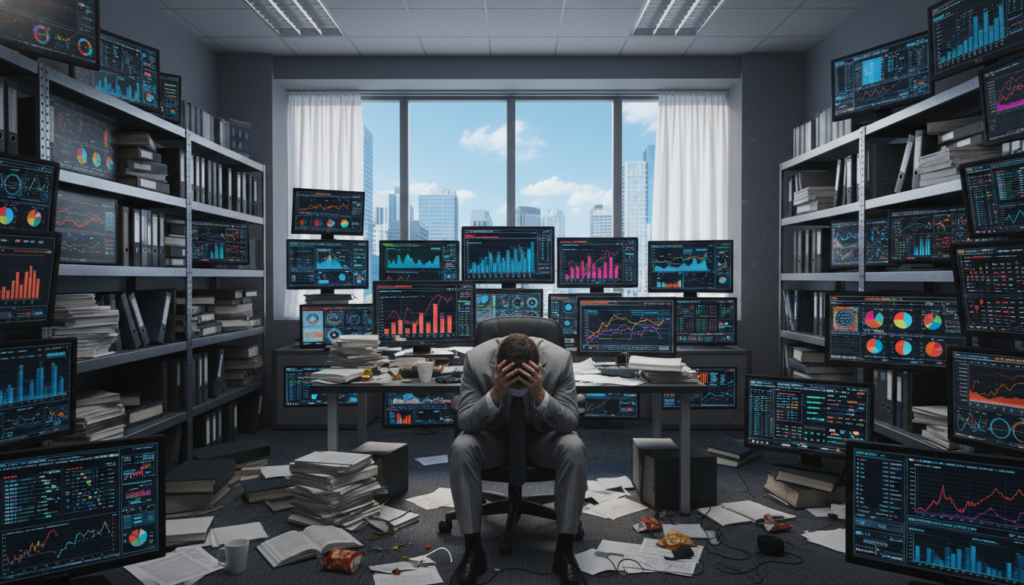
Fact: One study found that shoppers given 24 jams were half as likely to buy than those shown six, a figure that highlights how choice can backfire.
Analysis paralysis and choice overload name decision states where a growing set of alternatives raises mental demands during a decision process. This can slow or stall choices and lower satisfaction.
Researchers frame decision-making as limited by attention and mental resources. As options multiply, evaluation changes: more comparisons, more memory load, and heavier reliance on simple rules.
This section outlines what research and theory say about why many choices feel harder, not whether having choices is good or bad. It previews mechanisms used later: comparison load, working memory limits, heuristics, and decision fatigue.
Everyday U.S. settings—online shopping, long menus, streaming catalogs, and workplace tools—show where overload is commonly noticed. Results vary by context and study size, so the effect is not a single universal rule.
What analysis paralysis and choice overload mean in decision-making research
Decision researchers use the label choice overload to describe situations where a rising set of alternatives makes selecting one much harder. In this usage, overload refers to extra mental work during a decision process: more comparisons, heavier memory demands, and longer search times.
Choice overload as an impairment during choices
In studies, choice overload (sometimes called overchoice) names conditions when a larger number of options raises evaluation difficulty. Researchers treat the term descriptively: attention, comparison, and information handling can degrade as the option set grows.
Origins and modern use
The phrase traces back to Alvin Toffler’s 1970 book Future Shock, which linked expanding choice to strain in modern society. Since then, psychologists and behavioral economists have used the label to study how people make decisions under limited time and attention.
- Research frames overload as context-dependent rather than inevitable.
- Common domains include consumer selection, topic choice for learning, and workplace prioritization.
- Many studies distinguish the lived experience—often called analysis paralysis—from mere preference sorting.
Overall, this definition sets up later sections that examine specific models, classic experiments, and real-world examples where these labels appear. As a fact, effects vary by task and familiarity with the choice set.
Why many options can strain the mind: established models and constraints
Several theoretical frameworks explain why handling a large set of options strains mental resources during a decision. These models focus on limits in time, memory, and attention rather than on taste or preference.
Bounded rationality and limited resources
Bounded rationality frames decision makers as satisficers: they aim for good-enough outcomes because time and information are scarce. Evaluating many alternatives raises search costs and raises the burden on those finite resources.
Working memory and comparison load
Working memory limits mean people can only hold a few attributes in mind. Miller’s often-cited “five to nine” idea summarizes why comparing large sets triggers simplifying moves.
More options increase pairwise comparisons and attribute trade-offs, which multiplies the information to track during a single process.
Heuristics and simplification
Under overload, people use heuristics: single-attribute focus, familiar brands, or social proof. These rules of thumb reduce mental work but can bias decisions.
Decision fatigue and debate
Decision fatigue suggests repeated choices make later ones feel harder. This idea links to “ego depletion,” though recent studies question how consistent that effect is. Scholars treat it as a debated mechanism rather than settled fact.
Analysis Paralysis: The Cognitive Cost of Too Many Options
When choice sets grow, each new item adds mental tasks that slow down a person’s path to a decision. As options increase, people must search more, compare attributes, and weigh trade-offs that were not obvious at first.
How more options raise information and time demands
Each extra option adds reading and filtering work. That raises the time needed to scan descriptions, revisit earlier items, and test new combinations against criteria.
Trade-off complexity grows when choices differ across price, quality, features, or risk. Those multi-attribute differences force more side-by-side checks and make decisions feel harder.
Different approaches: maximizers versus satisficers
Maximizers keep searching for the best available choice, which lengthens evaluation and raises regret risk. Satisficers stop when a candidate meets their key cutoffs and move on faster.
- Maximizers increase depth of analysis and revisit options often.
- Satisficers trade thoroughness for speed and lower search time.
In everyday U.S. contexts—picking a phone plan, comparing insurance tiers, or shopping online—small differences between options can amplify paralysis rather than simplify it. This pattern describes stalled decision activity under high evaluation load, not a moral failing.
What research shows: classic studies and where findings vary
A set of well-known experiments shows how bigger assortments can draw interest but reduce follow-through. These studies separate initial attention from later action and highlight different mechanisms at work.
Jam display: attention versus purchase
Iyengar and Lepper ran a field study in Menlo Park offering 24 jams versus 6 jams. About 60% of passers-by stopped at the large table versus 40% at the small one.
Yet purchase rates diverged: roughly 3% bought from the large display and about 30% bought from the small display. Sampling averaged one to two jams in both setups.
Topic choice and completion
In a classroom experiment, students given six essay topics submitted at about 75%, while those given thirty topics submitted at about 60%. The result links greater selection to lower completion in that setting.
Chocolate tests and subjective experience
Chocolate-choice experiments find larger assortments often feel more difficult and frustrating and can lower later satisfaction. Sometimes people enjoy variety yet report reduced contentment after choosing.
“Large sets can increase attention but reduce commitment,” said one summary of these results.
Replication attempts and meta-analytic work show mixed effects. Later studies sometimes fail to reproduce large differences, and interpretation can reflect sampling, context, and confirmation bias. For a wider review, see this choice overload review.
How analysis paralysis appears in everyday life in the United States
In stores and online, larger assortments often shift consumer behavior from quick picks to extended searches across pages and reviews.
Big-box retail and online shopping
U.S. shoppers face many near-identical listings, variant SKUs, and long filter menus. This raises search work as people jump between tabs, compare specs, and read reviews.
Such browsing increases time per decision and makes revisiting earlier items common.
Restaurant menus and scanning burden
A restaurant menu with multiple sections, daily specials, and modifiers creates a layered set of choices. People scan categories quickly and often re-scan to check trade-offs like price and portion.
Streaming platforms and endless catalogs
On streaming sites, catalogs feel limitless. Selection shifts from a fixed list to navigation through rankings, recommendations, and trending cues.
That process makes one thing clear: choice can move viewers into cycles of previewing, queuing, and deferring play.
Work, productivity, and task prioritization
At work, selecting tools, meeting agendas, or methods forces the same filtering and narrowing seen in stores. Productivity choices often cost attention and create stalled plans when options pile up.
High-stakes life decisions
Education, job offers, and major purchases add uncertainty. People gather more data, compare more features, and delay final decisions because outcomes feel consequential in everyday life.
- Examples show repeated behaviors: filtering, narrowing, revisiting, and deferring.
- Across shopping, dining, streaming, and work, the mechanics are similar: search load, side-by-side checks, and attention shifts.
Common misunderstandings and oversimplified explanations
Popular summaries often treat large assortments as uniformly harmful, but that view misses key moderators. Context, task goals, and prior knowledge change whether extra selection helps or hinders a choice.
Why “more choice is always worse” is overstated. That claim ignores whether people have stable preferences or expertise. For routine picks, added options rarely create trouble. For unfamiliar, multi-attribute choices, extra items raise comparison work.
Interpretive bias can arise when a few famous studies are treated as definitive. Mixed replication and varied designs mean the same result does not appear in every setting. Treating one experiment as a universal fact is a category error.
What this is not
- Analysis paralysis is a situational struggle to resolve trade-offs; it differs from procrastination, which can stem from avoidance or low motivation.
- It also differs from indecision as a personality trait; overload often appears only in certain contexts.
In short, choice overload and related labels describe a specific phenomenon with boundaries. Clear language helps avoid collapsing separate causes—decision fatigue, anxiety, and motivation—into one neat explanation.
Boundaries and limitations: when many choices do not cause paralysis
Well-defined tastes and clear goals shrink an apparent shelf of options into a manageable shortlist.
Familiarity and expertise
When people know a domain, they group items by known patterns and recall key attributes faster.
Experts need less comparison and use stored rules to cut information and save resources. In familiar settings, higher counts rarely slow a choice.
Clear preferences and narrower search
Stable preferences reduce the effective number of options because only a few features matter.
That narrowing lowers search time and makes the decision feel straightforward rather than taxing.
Structure: categories, defaults, and chunking
Presentation changes perceived load. Grouped menus, labeled categories, and sensible defaults let people skip many comparisons.
Thus raw number alone is less predictive than how choices are organized.
Time pressure and context
Limited time raises perceived overload by forcing quick comparisons and reducing cognitive resources.
Conversely, relaxed contexts or clear stakes reduce stress and the effect seen in lab studies over the years.
- Similarity among items and attribute complexity also alter the phenomenon.
- Interfaces and retail layouts offer ways and strategies that shift how many items actually matter.
- These moderators explain why results vary across studies and real-world settings.
Concrete examples that illustrate the mechanics of overload
Concrete retail and digital cases show how visible design choices change what people actually pick. These examples link visible labels, counts, and signals to how attention shifts and how selection effort rises.
Jam display: attention versus follow-through
The classic jam example shows a clear split: a large table drew more browsers but far fewer buyers than a small table. That pattern ties to attention allocation—many options attract visits but increase comparisons at checkout.
Sales and satisfaction moved in opposite directions, and money spent per passer-by fell with the larger set.
Restaurant menu redesign and chunking
Cowry Consulting’s work with Mitchells & Butlers grouped dishes by course and category. Fewer visible items at once reduced scanning and cut cross-category comparisons.
Chunking raised average spend by about 13 pence per head while lowering unstructured search across the full menu.
Streaming cues and reduced choice sets
Netflix uses signals like “Trending” and “Top 10” and a “Play Something” shortcut. Those cues create a smaller, highlighted subset and sometimes remove a selection step.
Such social-proof markers change where attention lands and speed the pick process.
Insurance tiers and inference load
Lloyds Bank trials found three tiers often prompt questions about missing features, while two clear options (basic vs extras) made comparisons more direct. That change reduced information inference and altered premium scrutiny.
- Each case links to one mechanism: attention allocation, chunking, social proof, or reduced comparisons.
- Across these cases, visible design shapes the decision process and, in money-related choices, influences satisfaction and spending.
Conclusion
Research and case work show that rising option counts change how people allocate attention during choices. In brief, analysis paralysis and related overload describe a decision process where added items increase comparisons and can exceed evaluation capacity.
Multiple lenses — bounded rationality, working memory limits, heuristics, and decision fatigue — describe overlapping mechanics. Classic work (jam, essay topics, chocolate) illustrates the pattern but later studies show effects depend on context and replication.
Key boundaries include expertise, clear preferences, and structured presentation, which alter how a given number feels. Common simplifications — that more choice is always worse or that paralysis equals procrastination — miss these conditions.
Today, in U.S. markets and the digital world, this topic remains an active subject for study and neutral description.