Anúncios
Human reasoning is a complex process that involves making sense of the world around us. Cognitive psychology has long been fascinated by how we simplify complex information to make decisions.
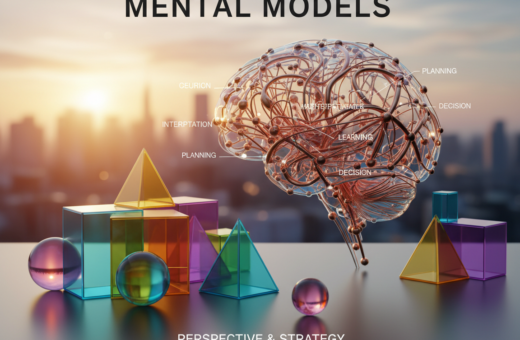
Mental models are a crucial concept in this field, referring to the internal representations or frameworks that help us understand and navigate the world.
By using mental models, individuals can better comprehend complex systems and make more informed decisions. This concept has far-reaching implications for various fields, from decision-making to problem-solving.
The significance of mental models lies in their ability to simplify complex information, making it easier to reason and make decisions.
The Cognitive Framework of Mental Models
## The Cognitive Framework of Mental Models
The cognitive framework of mental models is a foundational concept in understanding how humans process information and make decisions. Mental models arecognitive representationsthat simplify complex realities, enabling individuals to make predictions, explain phenomena, and decide on actions.
Anúncios
### Definition and Core Concepts
Mental models are constructed based on experiences, knowledge, and perceptions. The core concept revolves around simplifying complex systems. Key aspects include:
- Simplification of complex systems
- Representation of real-world phenomena
- Facilitating decision-making and problem-solving
### How Mental Models Shape Our Thinking
Mental models significantly influence our thought processes and decision-making. By providing a framework for understanding the world, mental models help individuals:
- Interpret new information
- Make predictions about future events
- Evaluate the consequences of different actions
The Evolution of Mental Model Theory
The concept of mental models has undergone significant development since its inception. This evolution is marked by key milestones and contributions from various theorists.
Anúncios
Historical Development of the Concept
Mental model theory has its roots in cognitive psychology, emerging as a crucial framework for understanding human reasoning and decision-making. Early work in this area laid the foundation for understanding how people process information and make decisions.
Key Theorists and Their Contributions
Several key theorists have contributed to the development of mental model theory. Philip Johnson-Laird is notably recognized for his work on mental models, providing a comprehensive framework for understanding reasoning and decision-making processes. Other researchers, such as Kent Holyoak and Richard Nisbett, have also made significant contributions by exploring the analogical reasoning and cognitive biases that influence mental models.
Types of Mental Models in Cognitive Psychology
The study of mental models in cognitive psychology reveals a diverse range of cognitive frameworks that help individuals understand and navigate their environment. These mental models are essential for processing information, making decisions, and solving problems.
Analogical Models
Analogical models are a type of mental model that involves making comparisons between two or more concepts to understand their relationships and structures. For instance, using a familiar system to explain a complex one, like comparing the human brain to a computer. Analogical reasoning is crucial for learning and problem-solving, as it enables individuals to transfer knowledge from one domain to another.
Causal Models
Causal models represent the causal relationships between events or variables. They help individuals understand cause-and-effect dynamics, making predictions about future outcomes based on past experiences. For example, understanding that a lack of rain (cause) can lead to drought (effect) involves a causal mental model. These models are vital for decision-making and planning.
Spatial Models
Spatial models involve mental representations of physical spaces and the relationships between objects within those spaces. These models are essential for navigation, architecture, and understanding complex systems. For instance, being able to mentally map a city or a building requires a spatial mental model. Such models facilitate tasks like giving directions or designing layouts.
In summary, the types of mental models discussed—analogical, causal, and spatial—each play a unique role in cognitive psychology, facilitating different aspects of human cognition and behavior. Understanding these models can provide insights into how individuals process information and interact with their environment.
How Mental Models Function in Human Reasoning
Human reasoning is significantly enhanced by mental models, which serve as frameworks for understanding and interpreting complex data. Mental models allow individuals to simplify complex systems, making it easier to analyze and make decisions based on the information available.
Information Processing and Mental Models
Mental models play a crucial role in information processing by providing a structured way to organize and simplify complex information. This enables individuals to focus on key elements and filter out irrelevant data. The process involves:
- Simplifying complex systems into manageable components
- Organizing information into coherent frameworks
- Facilitating the identification of patterns and relationships
By doing so, mental models enhance our ability to process information efficiently, leading to more effective decision-making.
The Role of Working Memory
Working memory is integral to the functioning of mental models in human reasoning. It temporarily holds and manipulates information, allowing for the cognitive processing necessary for reasoning and decision-making. The capacity of working memory can influence the complexity of mental models an individual can handle.
Key aspects of working memory’s role include:
- Temporary storage of information for immediate processing
- Managing cognitive load during complex tasks
- Facilitating the manipulation of information within mental models
Understanding the interplay between mental models and working memory can provide insights into improving cognitive performance and decision-making processes.
Comparing Mental Models to Other Cognitive Structures
To fully grasp the concept of mental models, it’s essential to compare and contrast them with other cognitive structures. Mental models are not isolated concepts; they are part of a broader cognitive framework that includes schemas and heuristics.
Comparative Analysis Table
A comparative analysis of mental models with other cognitive structures can be facilitated through the following table:
| Cognitive Structure | Description | Primary Function |
|---|---|---|
| Mental Models | Complex, dynamic representations of systems or phenomena | Reasoning and Problem-Solving |
| Schemas | Organized knowledge structures that help in interpreting information | Information Processing and Categorization |
| Heuristics | Mental shortcuts or rules of thumb for making decisions | Efficient Decision-Making |
Mental models and schemas both aid in understanding complex information, but mental models are more dynamic and often used for reasoning and problem-solving, whereas schemas are more about categorizing and interpreting information.
Mental Models vs. Heuristics
Mental models are detailed representations used for reasoning, while heuristics are simpler mental shortcuts used for efficient decision-making. Both are crucial but serve different cognitive functions.
Key Differences and Overlaps
While mental models, schemas, and heuristics are distinct cognitive structures, they overlap in their functions. Mental models and schemas both help in understanding complex information, albeit in different ways. Mental models and heuristics, though differing in complexity, both play critical roles in decision-making processes.
Common Mental Models Used in Decision-Making
In the realm of decision-making, certain mental models stand out for their utility and effectiveness. These models help individuals and organizations make more informed, rational decisions by providing frameworks for analysis and problem-solving.
First Principles Thinking
First principles thinking involves breaking down complex problems into their most basic elements and then reassembling them. This approach, often attributed to Aristotle and popularized by Elon Musk, encourages a deep understanding of the fundamental principles underlying a problem. By doing so, it allows for more innovative and effective solutions.
“The first principle is that you must not fool yourself and you are the easiest person to fool.” – Richard Feynman
Occam’s Razor
Occam’s Razor is a mental model that suggests, all things being equal, the simplest explanation or solution is usually the best one. This principle is invaluable in decision-making as it helps to cut through complexity and avoid unnecessary complications. It encourages decision-makers to favor solutions that require fewer assumptions and are more straightforward.
Second-Order Thinking
Second-order thinking involves considering not just the immediate consequences of a decision but also the potential second and third-order effects. This model encourages a more nuanced understanding of the potential outcomes of a decision, helping decision-makers to anticipate and prepare for future implications. It’s about thinking through the potential ripple effects of a choice, making it a powerful tool for more robust decision-making.
By incorporating these mental models into their decision-making processes, individuals and organizations can enhance their ability to make informed, effective decisions.
Mental Models in Problem-Solving Contexts
Mental models serve as essential tools in problem-solving, allowing for the breakdown of intricate problems into manageable components. By providing a simplified representation of complex systems, mental models enable individuals to analyze problems more effectively.
How Mental Models Facilitate Problem Analysis
Mental models facilitate problem analysis by offering a structured framework for understanding complex issues. They enable individuals to identify key variables, predict outcomes, and make informed decisions. For instance, analogical models can help in understanding unfamiliar concepts by relating them to familiar ideas.
The application of mental models in problem-solving also involves the use of causal models, which help in understanding the cause-and-effect relationships between different variables. This can lead to more effective solutions by addressing the root causes of problems.
Limitations in Problem-Solving Contexts
Despite their benefits, mental models have limitations in problem-solving contexts. One of the primary limitations is the potential for oversimplification of complex issues. Mental models can sometimes fail to capture the full complexity of a problem, leading to incomplete or inaccurate solutions.
Another limitation is the risk of cognitive biases influencing the development and application of mental models. Biases can lead to flawed assumptions and incorrect conclusions, undermining the effectiveness of problem-solving efforts.
Real-World Applications of Mental Models
Mental models have become an indispensable tool in various real-world applications, transforming how we approach complex problems. By simplifying complex systems into more manageable frameworks, mental models enable professionals across different fields to make more informed decisions.
Business and Management
In the business world, mental models are used to analyze market trends, predict consumer behavior, and develop strategic plans. For instance, companies like Amazon and Google rely on mental models to stay ahead of the competition by anticipating changes in consumer demand and technological advancements. According to a study on mental models for creative thinking, businesses can leverage these models to foster innovation and adaptability.
Education and Learning
In education, mental models play a crucial role in enhancing the learning experience. Teachers use mental models to explain complex concepts in simpler terms, making it easier for students to understand and retain information. For example, using analogies to describe scientific phenomena can significantly improve comprehension and engagement among students.
Artificial Intelligence Development
The development of artificial intelligence (AI) also benefits from mental models. AI systems are designed to mimic human thought processes, using mental models to simulate decision-making and problem-solving. This integration of mental models into AI development not only enhances the capabilities of AI systems but also provides insights into human cognition.
Mental models are versatile tools that have found applications across various domains. Their ability to simplify complex systems and enhance decision-making makes them invaluable in today’s fast-paced, information-rich world.
Biases and Limitations of Mental Models
Mental models, despite their benefits, can lead to errors in reasoning if not used carefully. While they help simplify complex information and facilitate decision-making, their limitations and potential biases must be understood to maximize their effectiveness.
Cognitive Biases Affecting Mental Models
Cognitive biases play a significant role in shaping our mental models. Biases such as confirmation bias, where individuals favor information that confirms their preconceived notions, can lead to inaccurate or incomplete mental models. Additionally, the availability heuristic, which involves judging the likelihood of an event based on how easily examples come to mind, can also distort mental models. Being aware of these biases is crucial to mitigating their impact.
When Mental Models Lead to Reasoning Errors
Mental models can lead to reasoning errors when they are overly simplistic or fail to account for critical variables. For instance, relying on a mental model that oversimplifies a complex issue can result in neglecting important factors, leading to suboptimal decisions. Furthermore, mental models can become outdated as new information becomes available, making it essential to regularly update and refine them.
Understanding these limitations is key to using mental models effectively. By acknowledging the potential for biases and errors, individuals can take steps to mitigate these risks, such as seeking diverse perspectives and continually updating their mental models.
Developing and Refining Effective Mental Models
Refining mental models is an ongoing process that requires continuous learning and adaptation. As we gather more information and experience, our mental models evolve to better reflect reality. Effective mental models are crucial for making informed decisions and solving complex problems.
Strategies for Building Better Mental Models
To build better mental models, one can employ several strategies. First, it’s essential to be open to new information and experiences. This can involve active learning and seeking out diverse perspectives. Additionally, practicing open-ended learning can help in developing more comprehensive models.
The Role of Metacognition in Model Refinement
Metacognition plays a critical role in refining mental models. By being aware of our thought processes, we can identify biases and areas for improvement.
“The most important thing in communication is hearing what isn’t said.”
This quote highlights the importance of metacognition in understanding the limitations of our mental models and refining them accordingly.
Conclusion: The Enduring Importance of Mental Models
The concept of mental models has proven to be a valuable tool in understanding human reasoning and decision-making processes. Throughout this article, we have explored the cognitive framework of mental models, their evolution, types, and applications in various fields.
The importance of mental models lies in their ability to simplify complex information, facilitate problem-solving, and enhance decision-making. By understanding and utilizing mental models effectively, individuals can improve their critical thinking skills and make more informed decisions.
In conclusion, mental models play a vital role in shaping our perceptions and guiding our actions. As we continue to navigate an increasingly complex world, the ability to develop and refine effective mental models will remain a crucial aspect of human cognition.