Anúncios
Clear frameworks help professionals turn messy information into fast, useful insights. These cognitive tools compress complex ideas so you can act with confidence.
Charlie Munger urged thinkers to jump across jurisdictional boundaries to spot chances others miss. That cross-discipline habit builds a sharper approach to tough decisions and bigger opportunities.
Use this guide to identify and apply these frameworks in business, education, and tech. It shows how simple principles—like first principles or second-order thinking—cut through noise and reduce bias.
Start small: learn core ideas from physics, economics, and human behavior. Over time, these tools let you navigate the modern world with clarity and avoid common pitfalls.
For deeper background and examples, see mental models and their role in human.
Anúncios
Understanding Mental Models for Reasoning
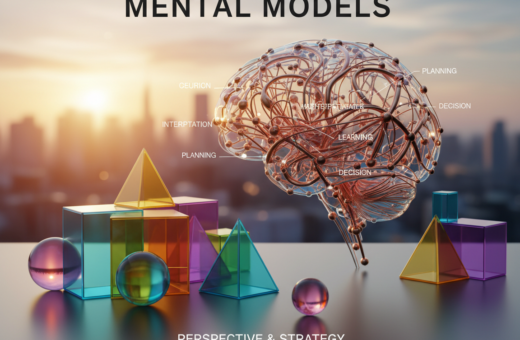
Effective internal representations transform vast information into manageable, action-ready ideas. This section explains core concepts and how these tools simplify complexity in work and study.
Core Concepts
A model is a simplified representation that maps key parts of a system and highlights relevant facts. Doyle and Ford (1998) argue that an individual’s structure often mirrors the external system it describes.
Johnson-Laird and Savary (1996) describe the principle of truth: people tend to hold only what they believe is true to reduce memory load. This explains why alternative possibilities are often overlooked.
Anúncios
Simplifying Complexity
These frameworks reduce overload by focusing attention on the most useful elements. That helps participants reach clearer conclusions and act with less hesitation.
- A model narrows information to what matters in a given situation.
- Research shows structured representations speed problem solving.
- Actively seeking alternate representations prevents the focusing effect.
Use multiple views to test assumptions and avoid single-perspective traps. Small shifts in representation can reveal new possibilities and better decisions.
The Map and the Territory
Maps and models help us sort what we notice from what actually happens in the world.
The map is not the territory reminds readers that any representation simplifies reality. A model highlights key processes but omits many details. That makes it useful and risky at the same time.
David Hume argued that our reasoning about fact rests on observed cause and effect. This theory explains why beliefs about causes shape action.
“Dr. Stockmann acts on causal beliefs about contaminated water to protect public health.”
Practical rules:
- Test representations against fresh information and changing context.
- Prefer transparent, revisable sources when you accept a map from others.
- Use multiple views to expose blind spots and new possibilities.
Defining Your Circle of Competence
A clear map of what you truly understand helps you avoid costly mistakes and wasted time.
Your circle of competence marks the domain where your knowledge and skills yield reliable judgments. Knowing those boundaries is more valuable than having a large but vague area of expertise.
Identifying Knowledge Boundaries
Start by listing topics where you can explain causes, offer practical solutions, and predict outcomes. Use simple tests: can you teach the idea to a colleague? Can you spot edge cases?
Operate inside that circle when the stakes are high. Stepping outside without a plan is like a sailor facing storms without charts—risk multiplies fast.
- Admit limits: a wise person asks for help when a problem lies beyond their scope.
- Grow deliberately: mastering new domains is a rewarding part of professional life.
- Use tools: a simple model or theory can reveal blind spots and speed learning.
“Confidence grows when you know what you know and when you know who to call.”
First Principles Thinking
First principles thinking breaks problems down to their base truths so you can rebuild solutions with clarity.
This method strips layers of assumption and shows what must be true. People who use this approach separate facts from habit. That helps them spot new possibilities instead of iterating on small fixes.
Rebels and disrupters often rely on first principles. They challenge the status quo and design systems from the ground up. That willingness to start fresh gives a real edge in business and tech.
How to apply it:
- Identify the core facts of a problem, not the accepted steps.
- Question each assumption until you reach irreducible truths.
- Reconstruct a new model based on those fundamentals.
“If you want something new, you must be willing to discard what you take for granted.”
Use this mental model when complexity hides root causes. Starting from first truths can turn a stubborn problem into a clear path forward.
The Power of Thought Experiments
Thought experiments give professionals a low-risk space to test bold ideas before applying them in real projects.
These exercises act as a sandbox of the mind. By creating a simplified model of reality, you can explore a theory and spot hidden assumptions.
A single “what if?” question often starts major breakthroughs. It forces a person to change the frame and trace likely outcomes over time.
- Strip noise and focus on core variables that drive the problem.
- Play out small tweaks to see how a system or process might respond.
- Reveal weak beliefs so teams can test them before costly action.
Use these exercises to clarify thinking and improve conclusions. They let individuals and participants explore possibilities without the confounding factors of real-world trials.
“Thought experiments turn abstract theory into concrete insight.”
Second Order Thinking
Second-order thinking asks us to trace outcomes two steps ahead, not just react to the obvious result.
Ask “And then what?” That simple question forces you to anticipate ripple effects over time. It shifts focus from immediate gains to how choices shape the future.
A chess master shows this most clearly. They plan moves that change the whole board and predict how an opponent will respond. This is the same way professionals should approach hard problems.
Most daily choices use first-order logic — what feels best now. Second-order thinking demands a longer view. It helps participants avoid traps and aim for better outcomes across careers.
- Look past the obvious effect.
- Map at least two steps of consequences.
- Revisit your plan when context or information changes.
“Decisions that survive time are the ones that account for what comes next.”
For a practical primer on this approach, see second-order thinking. Use this theory as a steady guide when complexity and change affect systems and people.
Probabilistic Thinking
Probabilistic thinking treats uncertainty as a tool. It asks you to name what matters, estimate odds, and update those estimates as new information arrives.
Being a probabilistic thinker means saying, “I don’t know for sure, but based on the evidence, I think there’s a 63 percent chance of X.”
This approach reduces overconfidence and makes decisions resilient. Professionals break a complex problem into key variables. Then they assign likelihoods and plan around several outcomes.
- Identify critical signals that change probabilities.
- Update beliefs quickly when new data arrives.
- Treat estimates as provisional, not final.
Benefits: better allocation of time, clearer communication with others, and a system that adapts as context changes.
“Estimating odds keeps teams honest and prepared.”
The Strategy of Inversion
Inversion flips the question: instead of chasing success, ask what would make failure certain.
This simple swap reveals blind spots. When you list what guarantees defeat, hidden obstacles become clear. That lets you remove or mitigate them early.
Use a mental models lens to guide the exercise. Start by naming actions, beliefs, or missing information that would ruin a plan.
Then work backward: block those paths and build safeguards. This approach shifts attention from chasing gains to preventing loss.
- Ask: “What would guarantee we fail?”
- Identify weak links, risky assumptions, and process gaps.
- Design simple rules to stop those failures from happening.
“Invert the problem to expose failure modes that conventional thinking hides.”
Applied to teams and projects, inversion reduces wasted time and increases the odds of meaningful change. Try it next time a tough problem stalls — the answers you need may appear once you aim away from the obvious path.
Applying Occam Razor
In practice, Occam’s razor helps professionals cut clutter and focus on the most likely cause.
Keep it simple: prefer the explanation that relies on the fewest assumptions when multiple answers fit the same facts.
This mental model does not claim the simplest theory is always true. It suggests that the simplest account should lead until richer evidence appears.
Balance matters. A model that is too simple misses important detail. A complex account can collapse under its own weight. Learn when simplicity points to truth and when nuance matters.
- Ask: which explanation needs the fewest extra steps?
- Test simple explanations first, then add complexity only when needed.
- Use this rule to save time and sharpen conclusions in teams and projects.
“Simplicity is the ultimate sophistication.”
Hanlon Razor in Professional Contexts
Start by attributing mistakes to incompetence instead of spite to reduce conflict and speed fixes.
The Hanlon Razor is a practical heuristic that prompts us to assume error rather than malice when actions seem harmful. People often act on incomplete information, forget steps, or make simple errors that look intentional.
Adopting this rule in teams lowers drama and keeps work moving. Instead of blaming others, leaders can ask clarifying questions and offer help. That response turns tension into a chance to improve processes and prevent repeat problems.
- Reduce escalation: look for gaps in communication or process before assigning intent.
- Respond with clarity: frame feedback as a way to fix a problem, not punish a person.
- Build goodwill: generous assumptions preserve trust and speed collaboration.
Use Hanlon’s Razor as a simple model to keep disputes small and solutions practical.
“Assume oversight, not ill will, and you buy time to solve real problems.”
Relativity and Subjective Perception
Every observer carries a private lens that changes the shape of facts they encounter. This section shows how perspective alters what we notice and how that affects judgment in work and daily life.
Subjective Vantage Points
People interpret the same event differently because their social context and past experience guide attention. A single piece of information can split into multiple narratives when viewed by distinct individuals.
Two people at the same meeting may leave with opposite conclusions. That difference comes from prior beliefs, personal goals, and simple habits of thought.
Expanding Frames of Reference
To reduce blind spots, actively seek others’ takes and ask, “What am I missing?” Expanding your frame of reference reveals fresh possibilities and leads to better shared conclusions.
- Invite diverse participants to challenge assumptions.
- Test your representation against alternative cases and contexts.
- Use a simple model to map how interpretations spread through a system.
“Understanding that perception is relative lets teams trade blame for curiosity.”
Practical rule: check your assumptions and treat different views as data, not threats. That habit improves thinking, reduces conflict, and helps solve problems across time and change.
The Principle of Reciprocity
Reciprocity acts like social gravity, pulling interactions toward mutual exchange.
Reciprocity is the simple idea of treating others as they treat us. It underpins everyday kindness, trade, and many social systems.
Give people the benefit of the doubt and the chance to succeed, and you often receive the same behavior back. Small positive actions shift expectations and change how participants behave over time.
One useful model is to go first. Waiting for someone else to act wastes opportunity. When a person leads with generosity or help, that move usually multiplies across a group.
- Deserve success: act in ways that make success natural and repeatable.
- Unlock momentum: small favors create large reciprocal effects in a system.
- Think long time: actions return to you over months and years, not just days.
“Our actions do not happen in isolation; they are part of an interconnected web that tends to come back to us over time.”
Thermodynamics as an Intellectual Framework
Thermodynamic ideas give us a steady lens to view energy, work, and the flow of change in systems.
Energy Conservation
The first law says energy never vanishes; it only changes shape. That rule helps teams track inputs and outputs in projects, budgets, and processes.
Treat resources as conserved units. Shifts in one place create effects elsewhere. This approach makes hidden trade-offs visible and improves planning.
Entropy and Disorder
Entropy predicts that closed systems tend toward disorder over time. In plain terms: left alone, a room grows messy and a process degrades.
Use this as a simple model to design maintenance, feedback loops, and buffers. Small interventions can slow decline and preserve value.
- Energy flows move value between parts of a system.
- Conservation thinking reveals hidden costs and transfers.
- Entropy warns that upkeep and redundancy are practical rules.
“Feeling the sun on your skin links a human moment to a process that began in a star 93 million miles away.”
Practical takeaways: apply these ideas to systems and decisions. They sharpen conclusions and show why small actions matter over time.
Inertia and Resistance to Change
Inertia explains why habits, institutions, and plans often resist even the best intentions. The physical law—that objects at rest stay at rest—serves as a clear model to understand human behavior.
At the personal level, the path of least resistance favors the status quo. Breaking a routine usually succeeds when you shrink the target into tiny steps. This approach reduces friction and makes new behavior stick.
In business, past success creates organizational inertia. Large firms often carry processes and beliefs that slow change. Startups, by contrast, have less baggage and can pivot faster.
Practical rules:
- Map where resistance lives in a system and address small frictions first.
- Use repeated, modest actions to build momentum over time.
- Guard against complacency: review assumptions and update representations when context shifts.
“Sustained force beats a single push; momentum is the ally of lasting change.”
Friction and Viscosity in Systems
Every system carries tiny resistances that shape what moves and what stalls. Friction is the grip between surfaces; viscosity is the thickness that makes fluids move slowly. Both act like sand in the gears of the world and limit how fast action spreads.
Friction is not all bad. It gives traction so people can walk, hold tools, and tie knots. Viscosity, however, raises costs in machines: thick fluids need more pump power and add strain to equipment. These forces show up in social and technical systems alike.
- Spot the drag: map where resistance concentrates in a process or system.
- Design for traction: add controlled friction where stability matters.
- Reduce needless viscosity: thin out steps that slow information flow.
“Small resistances determine big outcomes; designing with them in mind saves time and energy.”
Conclusion
Use this guide as a toolkit. Treat the ideas here as practical aids you can apply across work and life. They help you spot trade-offs, test assumptions, and act with more clarity.
Mastering a few core methods strengthens your ability to handle uncertainty. By applying these lenses consistently, you avoid common traps and make better decisions in complex settings.
Learning never ends: the most effective people keep refining their cognitive toolkit. The goal is not to know everything, but to grasp big ideas that reveal clearer paths forward.
We hope this conclusion helps you continue growing and using these concepts to improve outcomes and professional success.